




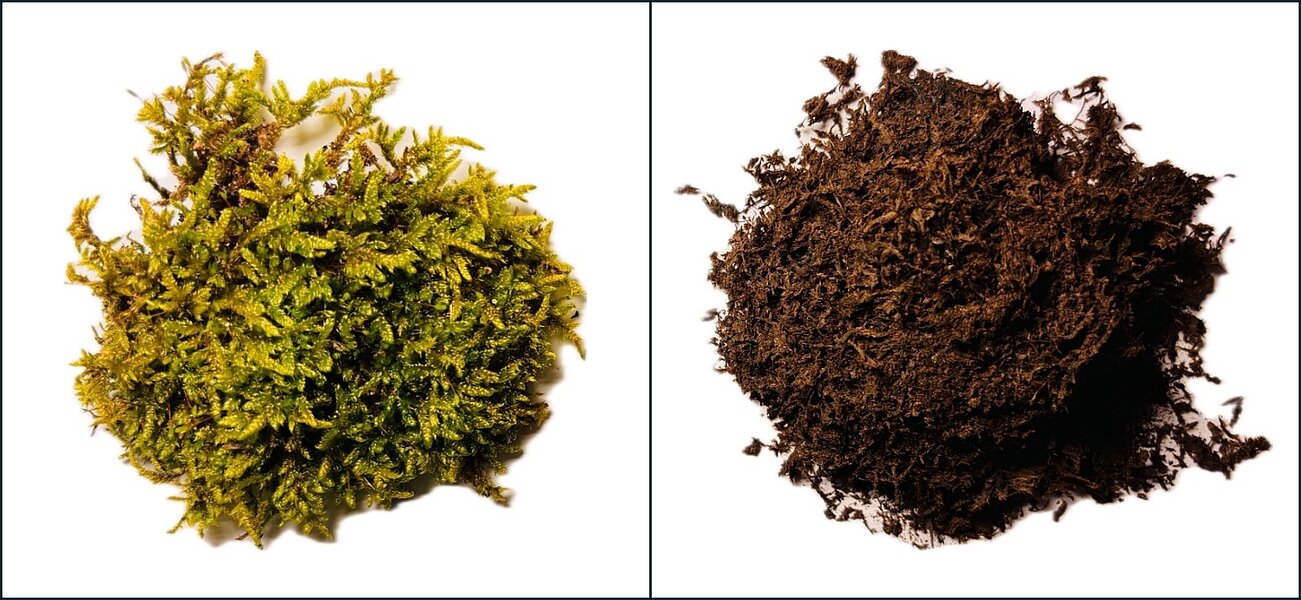
An outstanding success for ATB’s bioeconomy research: with his novel technology for producing “artificial peat”, ATB researcher Nader Marzban has been selected as one of six finalists in the “Scientists for Nature Challenge” at the 75th Lindau Nobel Laureate Meeting. In a highly competitive international selection process, which attracted a record number of applications from more than 25 countries this year, the innovative approach was recognized alongside projects from leading institutions including MIT and TUM.
ATB’s technology (patent pending) has been selected for the “A Quantum Leap for Biodiversity” programme, which seeks revolutionary and scalable solutions to reverse biodiversity loss. On 29 June, Nader Mazban will present the approach to Nobel laureates and an international audience from the worlds of science, business and philanthropy.
From millennia to minutes: a technological revolution for climate protection
The technology developed at ATB accelerates the processes of peat formation and humification – which take millennia in nature – into a controllable process lasting just a few minutes. It thus offers a promising solution to one of the most pressing climate issues: the drainage and degradation of peatlands. These are responsible for around five to seven per cent of Europe’s total greenhouse gas emissions. The artificial peat can serve as a peat substitute in growing media, thereby significantly reducing the pressure on natural peatlands.
“Being selected for this highly innovative challenge and having the opportunity to present our technology to Nobel laureates, leading researchers, and international supporters committed to biodiversity and nature protection is an immense honour and a powerful motivation,” says Nader Mazban. “We view planetary crises — with seven of the nine planetary boundaries already crossed — such as climate change and biodiversity loss as interconnected consequences of humanity’s imbalanced relationship with nature. Our aim is to utilize diverse lignocellulosic biomasses, including biomass from paludiculture systems on rewetted peatlands and other biogenic residues, to develop practical and scalable bioeconomy approaches rooted in real ecosystems and circular resource flows. We believe future technologies must not only optimize processes, but also help restore balance between human activity, biodiversity, and the ecological systems upon which societies depend. At the same time, technologies should be transferable across different regions and economic contexts to bridge the gap between scientific innovation and real-world implementation. Real progress will require collective effort, interdisciplinary thinking, and the recognition that humans, animals and nature are inextricably dependent on one another."
Nader Mazban already took part in the 74th Lindau Nobel Laureate Meeting last year as one of nine young researchers of the Leibniz Association. This enabled him to apply for the “Scientists for Nature Challenge” this year.
Recognition for systemic research with practical relevance
Selection for the “Scientists for Nature Challenge” includes prize funding of up to 10,000 euros, as well as access to a tailored mentoring and coaching programme that connects the finalists — including teams from ATB, MIT, TUM, CEAB, UUlm and UWA – with a select international network of investors, philanthropists, scientists, and innovation partners.
Prof. Dr Barbara Sturm, Scientific Director of ATB, emphasises the strategic significance of this success: “This award underscores the enormous relevance and innovative potential of our systemic research. It demonstrates how we at ATB are laying the scientific foundations to drive the transformation towards a sustainable, circular bioeconomy with concrete technological solutions. With our deep-tech approach, we directly contribute to the goals of the High-Tech Agenda. As an integral component of our 'Smart Biorefinery' concept, artificial peat is a prime example of how we can combine ecological imperatives with economic opportunities, thereby strategically strengthening the 'Innohof' as a hub of innovation.
We are particularly delighted that this success is significantly driven by our extremely talented young scientists as demonstrated by this invention. Their creativity, dedication, and scientific excellence are the engine for such breakthroughs. This award is therefore not only a recognition for the project itself, but also a wonderful confirmation of our strategic commitment to fostering young talents at ATB, which is a core priority for us.
A special and heartfelt thank you goes to Nader Marzban for being the driving force behind this innovation."
A team success
The development of the technology is the result of intensive interdisciplinary collaboration. The core team and key partners include: Prof. Barbara Sturm (ATB), Prof. Nicole M. van Dam (Leibniz Institute of Vegetable and Ornamental Crops, IGZ), Dr Thomas Hoffmann (ATB), Prof. Vera Susanne Rotter (Technical University of Berlin) and Dr Ralf Pecenka (ATB).
About “Scientists for Nature Challenge”:
The Families for Nature Foundation is an international philanthropic initiative dedicated to supporting transformative scientific and technological solutions for biodiversity protection, climate resilience, and ecosystem restoration. In collaboration with the Lindau Nobel Laureate Meetings, the foundation organizes the “Scientists for Nature Challenge” which connects outstanding young researchers with Nobel Laureates, scientists, investors, philanthropists, and innovation networks to help accelerate the transition from scientific discovery to real-world impact.
About ATB research on Smart biorefineries and artificial peat
Smart integrated biorefineries in bioeconomy: A concept toward zero-waste, emission reduction, and self-sufficient energy production
Mimicking peat formation through selective alkaline humification enables scalable artificial peat
Maximizing the value of liquid products and minimizing carbon loss in hydrothermal processing of biomass: an evolution from carbonization to humification
Artificial humic substances for agriculture Smart biorefineries Artificial peat
Contact
Dr Nader Marzban
Scientist
Telephon: +49 331 5699-333
Email: NMarzban@atb-potsdam.de