




How can we safeguard Europe’s technological sovereignty whilst driving forward social and environmental change? To mark the 20th anniversary of the Leibniz Association’s European Office, around 150 invited guests from the worlds of politics, industry and academia gathered in Brussels on 1 September 2026. ATB demonstrated, both on the podium and in an accompanying exhibition, the central role that bioeconomic innovations play in ensuring the future viability of Germany and Europe.
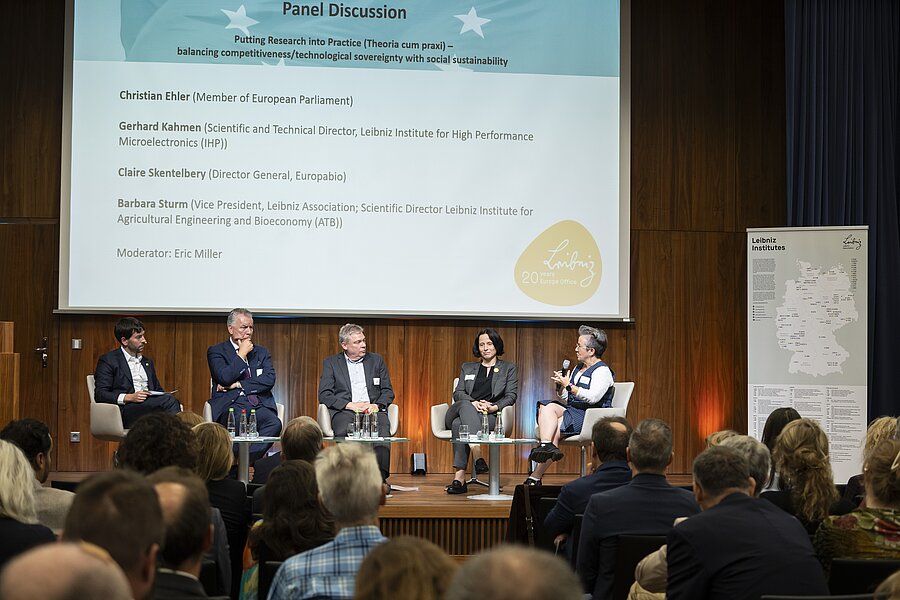
Under the theme “Theoria cum praxi: Competitiveness, sovereignty and society in transition. How does research strengthen Europe’s future and cohesion?”, the Leibniz Association’s European Office celebrated its 20th anniversary at the Representation of the State of Baden-Württemberg to the European Union. Following welcoming remarks by Leibniz President Christoph M. Schmidt and Baden-Württemberg’s Minister for Science, Petra Olschowski, as well as a keynote address by Prof. Dr Irene Bertschek (ZEW), Prof. Dr Barbara Sturm, Scientific Director of ATB and Vice-President of the Leibniz Association, took part in the main panel discussion.
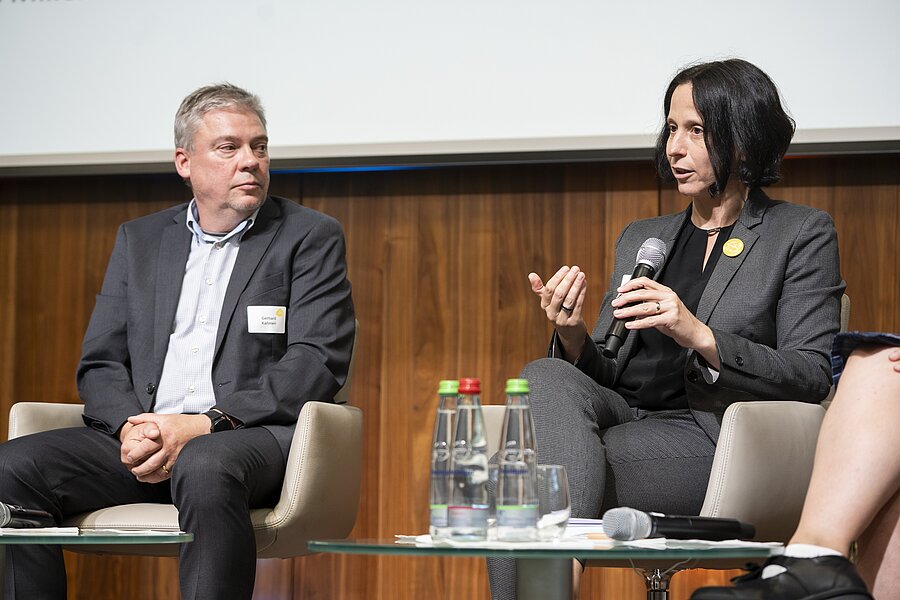
Together with Dr Christian Ehler (MEP), Prof. Dr Gerhard Kahmen (IHP) and Dr Claire Skentelbery (EuropaBio), Prof. Dr Barbara Sturm, Scientific Director of ATB and Vice-President of the Leibniz Association, discussed how research can strengthen Europe’s future and cohesion. The debates centred on the question of how innovations find their way into practice – in a way that is economically and internationally competitive and democratically legitimate. An accompanying reception provided an opportunity for in-depth discussions with European decision-makers.
Prof. Barbara Sturm summarises the discussions: “Europe is currently facing major challenges. To secure prosperity and independence, we need closed-loop systems and food systems that are both sustainable and resilient. We require reliable technological sovereignty that integrates economic strength with environmental sustainability and social responsibility. Scientific findings must therefore find a faster and more direct path into European legislation and practice in order to effectively strengthen resilience.”
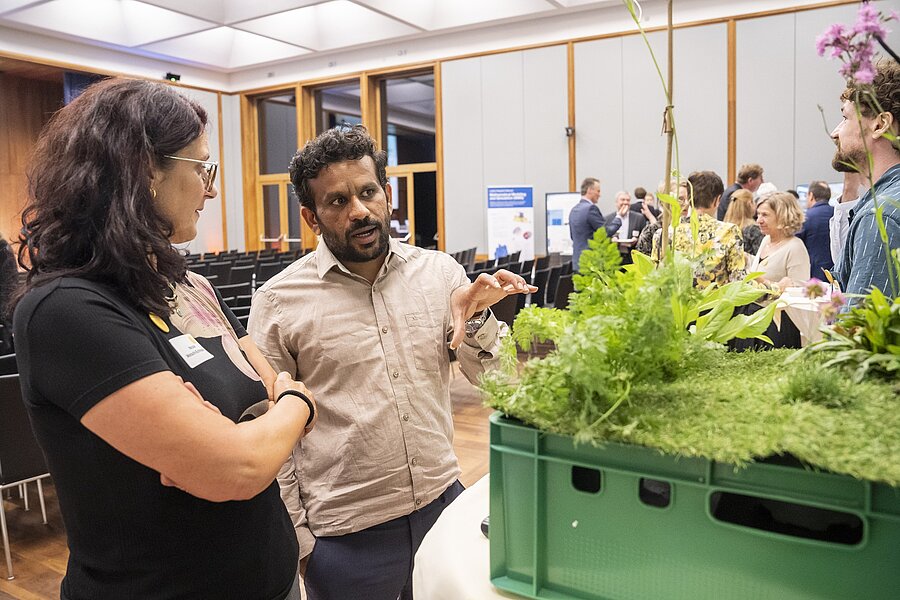
In addition, 27 selected Leibniz Institutes brought their cutting-edge research to life for guests in a themed exhibition. ATB contributed with two illustrative exhibits that demonstrated forward-looking solutions in agricultural technology and the bioeconomy:
- Precision monitoring in grassland: An exhibit on biodiversity indicator recognition illustrated how researchers in the DAKIS project use drone imagery and artificial intelligence (AI) to precisely identify individual grassland species in fields, thereby enabling targeted and automated monitoring of biodiversity. The project is coordinated by the Leibniz Centre for Agricultural Landscape Research (ZALF) e.V. ATB staff member Deepak Hanike Basavegowda attended the presentation in Brussels.
- Alternative proteins and bioresources: Coordinated by the Leibniz Institute for Horticultural Sciences (IGZ), the partners from the food4future – Food of the Future innovation cluster provided insights into novel marine cycles and resource utilisation under the motto ‘Shaping the Future together’. An algae reactor demonstrated how macroalgae can be cultivated under controlled conditions, whilst the mixed-reality application ‘Food Visions’ brought future food scenarios to life in a VR environment.
Both projects are funded by the Federal Ministry of Research, Technology and Space (BMFTR) as part of the ‘Agricultural Systems of the Future’ funding programme. The joint presentation highlighted the thematic breadth of the research projects.
We warmly congratulate the Leibniz Association and the team at the Brussels office on their 20th anniversary. It was both an honour and a pleasure to help organise this inspiring ceremony and to discuss pressing issues for the future in person. We very much look forward to continued cooperation at European level.