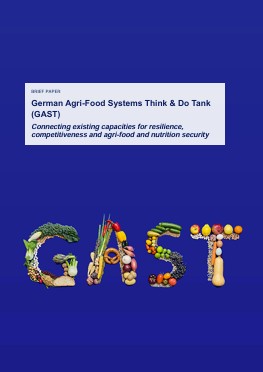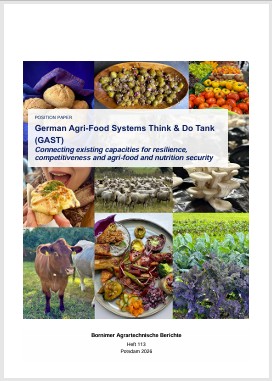






GAST - German Agri-Food Systems Think & Do Tank
Connecting research and practice for a resilient, competitive and secure agri-food system in Germany
GAST is an independent, cross-institutional initiative connecting existing activities and expertise across research, policy, business, practice and civil society. It brings scientific evidence and practical experience together on questions about food production, supply and consumption that span sectors or regions. GAST helps partners agree shared priorities, assess future options and connect findings with testing and implementation through existing organizations.
Our vision
A resilient, competitive and secure agri-food system in Germany that ensures access to affordable, safe and healthy food for all, supports economically viable farms, agri-food businesses, local initiatives and innovation ecosystems, and protects the ecological foundations of agri-food production.
Our mission
GAST builds a shared understanding of Germany’s agri-food system and its future pathways, and broad support for joint action toward greater resilience, competitiveness and agri-food and nutrition security. It provides independent science-based advice and advocates jointly developed, evidence-based positions in public and policy discussions.
How Think and Do work together
Think combines research, data, foresight and practical knowledge to assess evidence, identify uncertainties and explore future options.
Do connects this assessment with testing, demonstration and implementation through existing facilities, practice networks, businesses, public institutions and regional initiatives.





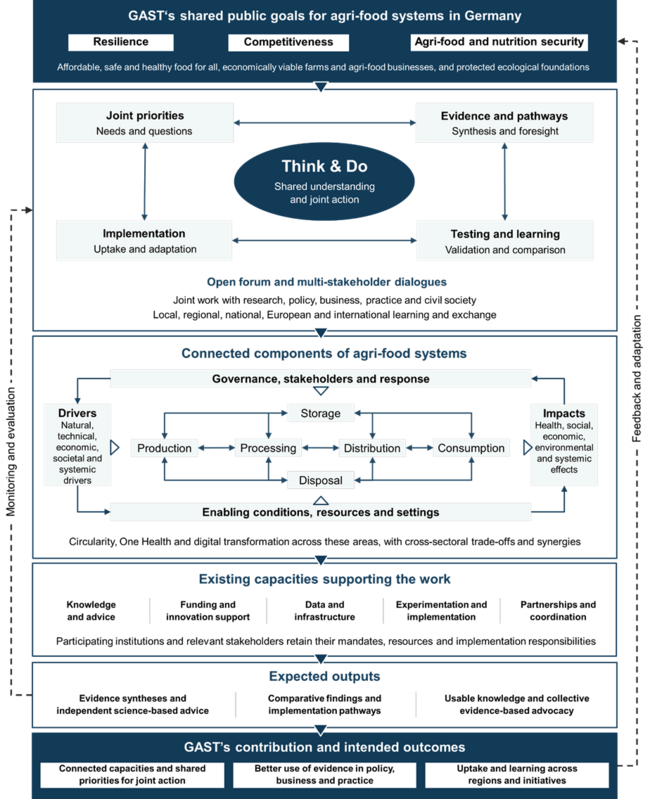
The GAST Compass for 2027
The Compass shows how priorities, evidence, testing and implementation inform one another. Dialogue, monitoring and evaluation support learning and adaptation.
The 2027 demonstration program
The 2027 demonstration program is in preparation. It will test where joint work through GAST adds value to existing activities. Three proposed priority topics are open for discussion.
- Foresight, system preparedness and pathways for resilient agri-food systems in Germany. Examine emerging risks, dependencies and future options.
- Shared understanding of agri-food systems. Define and map Germany’s agri-food system, its connections and relevant stakeholders, including missing perspectives.
- From research and innovation to implementation. Examine barriers to uptake and conditions for wider use of technical, organizational, behavioral and policy changes.
Following consultation with relevant stakeholder groups, participating partners will agree the topics and scope, considering public relevance, intended use, available evidence, feasibility and added value.
Participation and engagement
GAST welcomes new partners and contributors from research, public authorities, business, practice and civil society. Contributions can include topic suggestions, evidence, expertise, practical experience and opportunities for testing or implementation. GAST particularly welcomes perspectives missing from current discussions, including those of people affected by the issues.
To discuss participation, please contact Barbara Sturm and Naser Reyhani (nreyhani@atb-potsdam.de), GAST’s main contacts. Include your name, organization and a brief description of your interest, question or possible contribution.
Coordination and contacts
GAST is led by four core partners: the Leibniz Institute for Agricultural Engineering and Bioeconomy (ATB), the Hans Eisenmann-Forum for Agricultural Sciences at the Technical University of Munich (HEF@TUM), the University of Hohenheim and the Johann Heinrich von Thünen Institute. ATB and HEF@TUM are the joint administrative hosts for the preparation of the 2027 program.
Speaker: Barbara Sturm · director@atb-potsdam.de
Co-speaker: Iris Lewandowski · iris_lewandowski@uni-hohenheim.de
Co-speaker: Martin Banse · martin.banse@thuenen.de
Coordinator: Naser Reyhani · nreyhani@atb-potsdam.de
News
GAST was launched on November 11, 2026. It will be presented in Bonn on November 18, 2026, at the Status Seminar on EU Partnerships, organized by BMLEH, BMFTR, BLE and PtJ.