




Data is a key resource for modern agricultural and food systems. However, its potential often remains untapped because it is stored in separate systems and is difficult to share. A new perspective paper by ATB, Thünen Institute, KTBL and Agrotech Valley Forum shows how federated data spaces can enable sovereign data sharing and thereby support innovation, food security and resilience to crises.
Whether on dairy farms, in food processing, in logistics or in the use of agricultural by-products: Large amounts of data are generated daily throughout the agricultural and food systems. This data describes production conditions, controls machinery and processes, supports compliance with legal requirements and forms the basis for operational decisions and new services.
However, it is often only possible to utilise this data across farm, company and authority boundaries at great expense. Interfaces are lacking, terminology and data formats are incompatible, and responsibilities are unclear. Information is recorded multiple times. At the same time, data protection, trade secrets and legitimate oversight interests must be safeguarded.
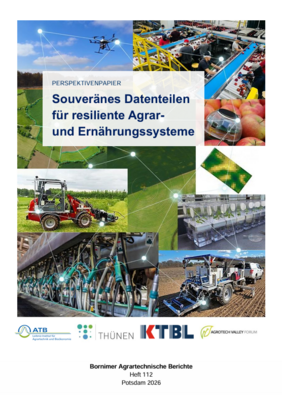
How can data be shared under these conditions? And how can linking this data help to identify risks earlier and enable coordinated action in crises? The perspective paper ‘Sovereign Data Sharing for Resilient Agricultural and Food Systems’ brings together the perspectives of the Leibniz Institute for Agricultural Engineering and Bioeconomy (ATB), the Thünen Institute, the Kuratorium für Technik und Bauwesen in der Landwirtschaft e.V. (KTBL) and the Agrotech Valley Forum.
Connecting existing systems under common rules
The authors advocate federated data spaces: existing and new data infrastructures are interconnected via common rules, standards and services. The data can remain within the respective systems whilst being made accessible and usable under agreed conditions.
This requires more than just compatible technology. Equally important are clear responsibilities, reliable digital identities, transparent rules on access and use, and the active involvement of stakeholders. Data providers and other authorised parties should be able to track and monitor who is using data, for what purpose and under what conditions. Open data and protected data should thus both be usable in an equally responsible manner.
Interconnected data for everyday life and for crises
Once recorded, information can be reused multiple times under regulated conditions – for example, for administration, consultancy, research and operational decision-making. This can reduce duplicate data entry, enable new services and facilitate collaboration within value-added networks as well as between industry, research and public authorities.
In the event of extreme weather, animal and plant diseases or disrupted supply chains, linked data can help to obtain reliable situational assessments more quickly and make more informed decisions. The paper therefore regards federated data spaces as strategic infrastructure for innovation, food security and resilience.
Utilising and sustainably maintaining existing building blocks
Germany and Europe are not starting from scratch in this regard. Public and scientific data infrastructures, industry initiatives, standards and pilot projects already provide important building blocks. Furthermore, the Common European Agricultural Data Space (CEADS) is creating a European federation to which national structures must be interoperable. It is crucial to coordinate the integration of existing solutions, develop them further and operate them on a long-term basis.
To this end, the paper sets out nine recommendations across three areas of action:
1. Strategic framework: prioritisation, interoperability and sustainability
Establish a shared political vision, connect existing systems in a federated manner and ensure their interoperability with CEADS. Responsibilities, operating models and long-term funding must be clarified. Public administration and research should lead the way with their own reliable data offerings.
2. Binding fundamental principles: sovereignty, trust and interoperability
The rights of stakeholders are effectively upheld through transparent rules and reliable identities. Common standards, unambiguous data descriptions and secure, sustainably maintained software should facilitate collaboration. Reuse should reduce administrative burdens and generate tangible benefits.
3. Practical implementation: implementation, empowerment and learning
Use cases should be developed and tested in collaboration with stakeholders. Advice, training, co-creation and fair incentives should enable even smaller players to participate. Scientific monitoring and continuous evaluation should reveal what works and where improvements are needed.
“We do not need to bring all data to one place. We must ensure that it can be used under reliable conditions – so that we can drive innovation and act in a well-informed and coordinated manner, even in times of crisis,” says Dr Anne Sennhenn, lead author of the paper at the ATB.
The authors advocate organising sovereign data sharing within a federated AgriFood data space as a long-term joint endeavour. Technology, rules, funding and expertise must be developed jointly for this purpose.
Original publication
Sennhenn A., Kraft M., Umstätter C., Kleinschmit B. , Martini D. ,Eberz-Eder D. , Müller H., Marzban N., Sturm B. (2026): Sovereign data sharing for resilient agri-food systems. Bornimer Agrartechnische Berichte, Heft 112. Online: https://nbn-resolving.org/urn:nbn:de:kobv:186-opus4-189800
Download perspective paper (German)
Contact
Dr Anne Sennhenn
FAIRagro Coordinator at ATB
asennhenn@atb-potsdam.de