






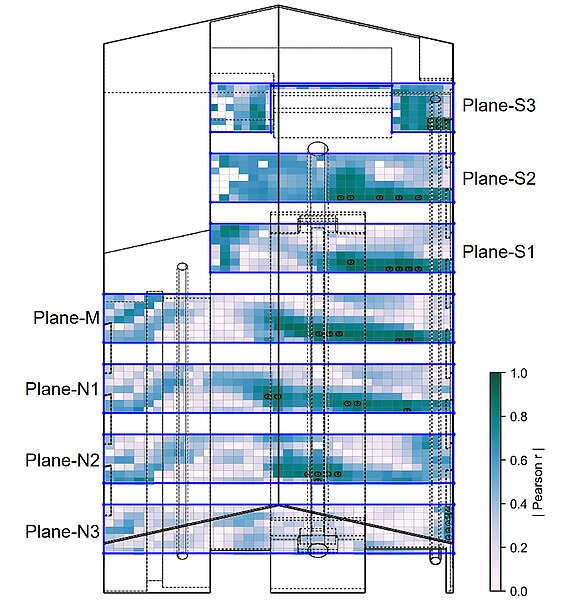
Where should a sensor be positioned to provide as much information as possible about air flow in a barn? Whilst more sensors do provide more data, they do not necessarily yield more insights. Researchers at the Leibniz Institute for Agricultural Engineering and Bioeconomy have now developed a data-driven approach that identifies the measurement positions yielding the most information. In doing so, they are laying the foundations for more efficient environmental monitoring and future mitigation measures in livestock housing.
Measuring better, not more.
Anyone wishing to measure air flows – and thus the spread of harmful gases – in a barn faces a major challenge: air is constantly moving, changing direction with every gust of wind and, depending on the building’s structure, creating complex flow patterns and vortices. In theory, measurements would need to be taken everywhere. At the same time, dense sensor networks make measurement campaigns expensive and are often impractical to implement.
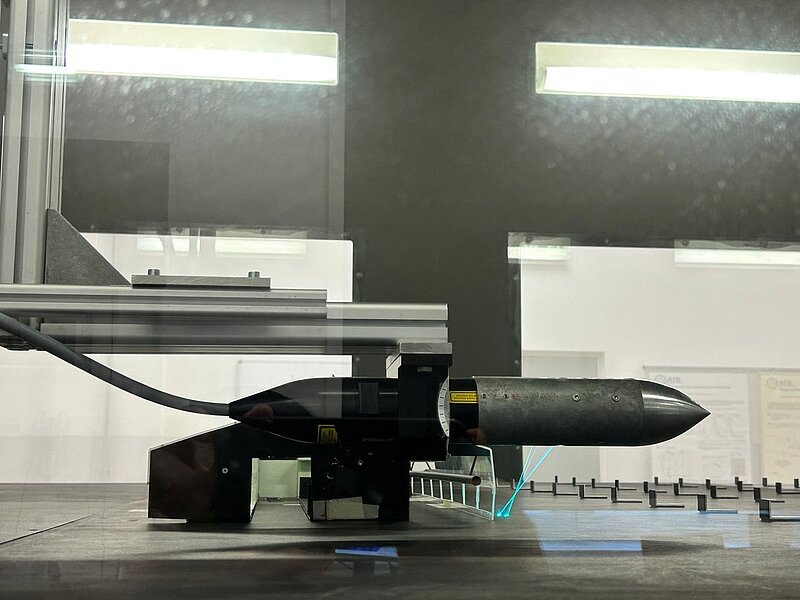
The crucial question is therefore: Where should sensors be placed to capture the most relevant information? ATB researchers have now published their new method in the journal Smart Agricultural Technology. Dr Long Chen, scientist at ATB and lead author of the study, explains: “We didn’t simply want to calculate as many flow simulations as possible, but rather those we could trust. Using Computational Fluid Dynamics, or CFD for short, we were able to calculate the air movement under different wind directions and flow conditions inside a naturally ventilated dairy barn. To ensure that the simulations were accurate, our great team at ATB validated the predictions in our large atmospheric boundary-layer wind tunnel. Because we only obtained a reliable reference database when the computer simulations and wind tunnel measurements yielded comparable results. We could hardly have achieved such accuracy with measurements in the barn alone.”
Identifying where data becomes particularly valuable
Based on the validated simulations, the researchers developed their actual approach. They used Shannon entropy, a mathematical measure of information content. Instead of asking where air moves particularly quickly, they asked where its behaviour changes most significantly under different wind conditions. It is precisely at these points that sensors promise to provide the most information, and these measurement points are linked to the local mean age of air, an important indicator of ventilation quality that describes how long air remains inside the barn on average.
“Our results show that, for the barn configuration investigated in this study, as few as 15 to 20 carefully positioned sensors can provide almost the same level of insight as a much denser measurement network. This opens up entirely new possibilities for monitoring barn climate both precisely and cost-effectively,” says Dr Long Chen.
A foundation for better mitigation measures
The study demonstrates how targeted flow simulations can be translated into concrete recommendations for practical application. This benefits not only future research projects. In the long term, the approach also lays the foundation for more efficient environmental monitoring systems in livestock housing. Additionally more reliable information about airflow patterns can improve the assessment of ventilation systems and support the development of targeted emission mitigation measures.
Publication
Contact
Dr Long Chen
Scientist
Telefon: +49 331 5699-524
E-Mail: lchen@atb-potsdam.de
Jessica Lietze
Presse- und Öffentlichkeitsarbeit
Telefon: +49 331 5699-819
E-Mail: presse@atb-potsdam.de