




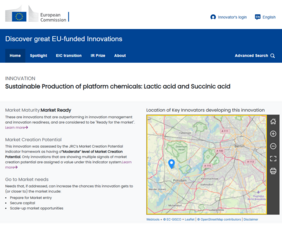
ATB's work on the development of bio-based materials has been recognised in the EU Innovation Radar as a particularly promising innovation. This recognition comes within the framework of the EU BIOMAC project, which is paving the way for sustainable nanomaterials to move from research into practical application. The aim was to overcome the often difficult transition and make innovative materials usable in practice.
Many innovative bio-based materials never make it from the laboratory to the market. This is often due to the high risks and enormous costs associated with scaling up production. This hurdle, often referred to as the ‘Valley of Death’, prevents promising sustainable alternatives to fossil-based materials from being widely adopted. To advance the bioeconomy, therefore, infrastructure and expertise are needed to specifically support this transition.
This is precisely where ATB's expertise comes into play. As one of the key innovators in the project, ATB operates a pilot plant for converting biomass. In the institute’s own pilot plant for biobased chemicals, researchers are developing and optimising processes to produce high-quality intermediates – such as lignin nanoparticles and cellulose nanocrystals – from plant-based raw materials and residues. These nanostructured, bio-based materials (NBMs for short) form the basis for new materials. The work at ATB thus makes a concrete contribution to bridging the gap between scientific concept and industrial application.
ATB's pilot plant is part of a Europe-wide network being established as an ‘Open Innovation Test Bed’ (OITB) within the BIOMAC project. This test bed provides a single entry point to a total of 17 interconnected pilot plants along the entire value chain – from biomass to the finished product. This enables companies to develop, test and bring new bio-based solutions to market without having to invest in expensive infrastructure themselves. This significantly reduces development times, costs and risks.
The BIOMAC consortium is coordinated by the Aristotle University of Thessaloniki. It brings together over 30 partners from research and industry to develop technologies for sectors such as packaging, agricultural engineering, construction and automotive manufacturing. Recognition in the EU Innovation Radar gives the approaches developed within the project – and thus also ATB's work – additional visibility for potential users and investors.
Background on BIOMAC
The European Sustainable BIO-based nanoMAterials Community (BIOMAC) project is funded by the EU’s Horizon 2020 research programme (Grant Agreement No 952941) and was active from January 2021 to June 2025. It is coordinated by Aristotle University of Thessaloniki (Greece). The Leibniz Institute for Agricultural Engineering and Bioeconomy (ATB) is one of the key research partners.
BIOMAC | European sustainable BIO-based nanoMAterials Community
Further key innovations by ATB in the EU Innovation Radar
This recognition in the EU Innovation Radar marks the second time that ATB has been honoured. Most recently, ATB’s developments within the RES4LIVE project were listed as a key innovation. In this project, researchers developed a decentralised on-farm refuelling station that processes biogas from waste materials such as manure directly on site into high-quality fuel (Bio-CNG). This enables farms to run their tractors without fossil fuels and strengthen their energy independence. The Innovation Radar classified this technology as technically mature (“Tech Ready”) with high market potential. This double recognition underlines ATB’s leading role in successfully translating scientific findings into practical and marketable solutions.