





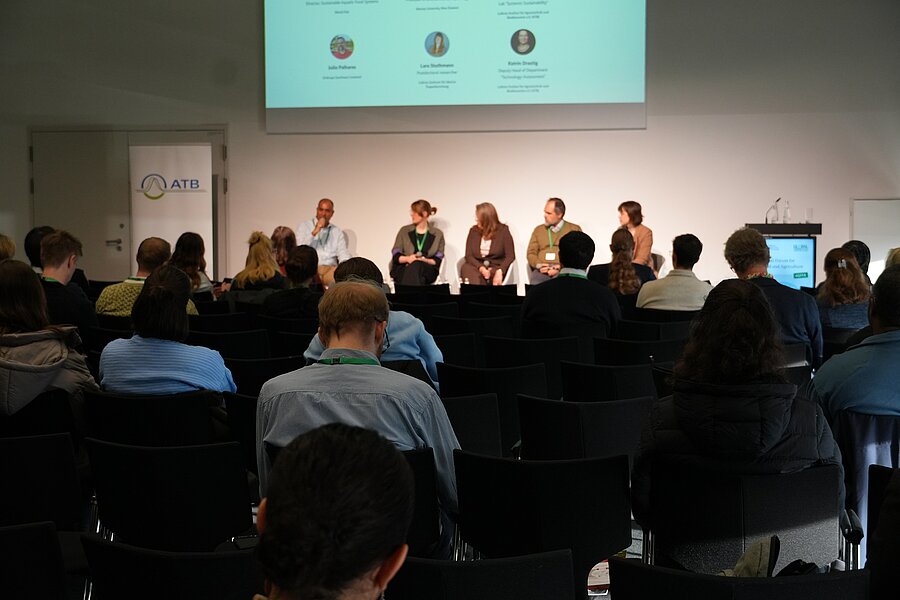
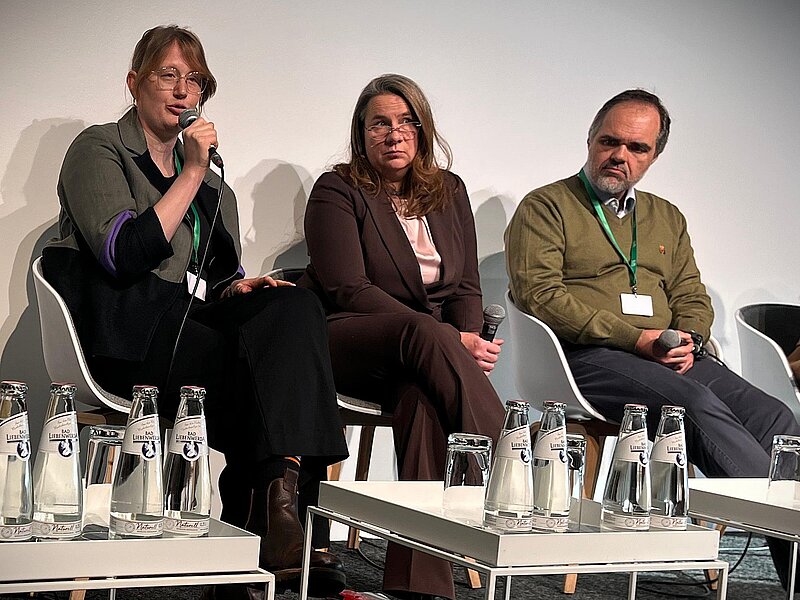
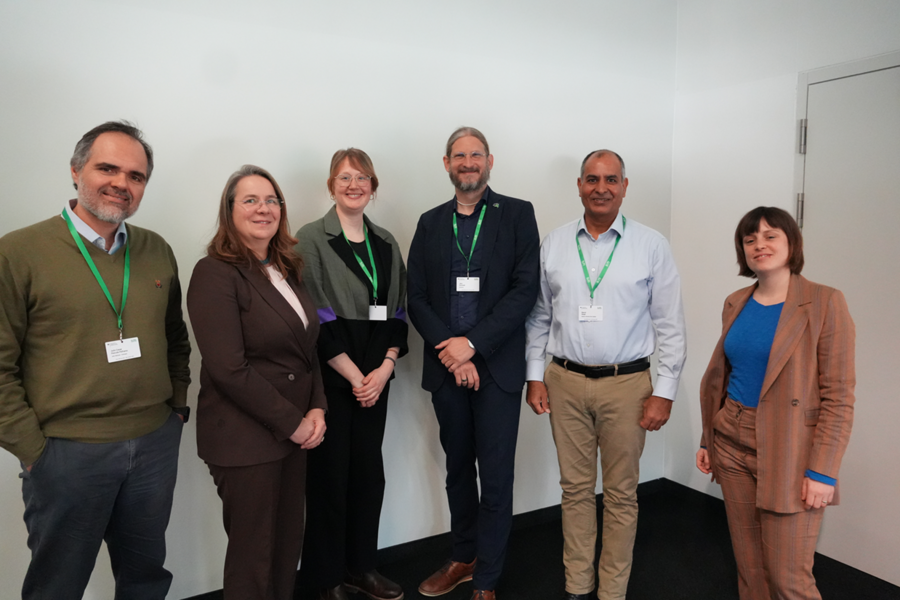
Under the motto "The blue-green interface: Innovations for smart water strategies from farm to sea," the Leibniz Institute for Agricultural Engineering and Bioeconomy (ATB) and the Leibniz Centre for Tropical Marine Research (ZMT) organised a panel discussion on 16 January 2026 as part of the Leibniz Lab Systemic Sustainability during the Global Forum for Food and Agriculture (GFFA) 2026. The GFFA is an important event within the framework of Green Week, bringing together politics, science, business and civil society to develop solutions for future food security. The overarching theme of this year's forum was "Water. Harvests. Our Future". Our expert panel emphasised the need to establish a systems approach across the interfaces of land, water and sea, and to consider blue and green bioeconomy solutions as an integrated space for innovation.
Participants discussed these issues with the two keynote spokespersons, Jörn Schmidt (WorldFish) and Prof. Ranvir Singh (Massey University, New Zealand), as well as the panel guests Dr Julio Palhares (Embrapa Southeast Livestock), Dr Lara Stuthmann (ZMT), Dr Katrin Drastig (ATB) and Prof. Ranvir Singh discussed innovations and the need for intelligent water strategies.
Four specific approaches were discussed with a view to making better use of water worldwide:
- Harmonise global water data: Water measurements should be standardised internationally with the aim of facilitating cooperation and planning supported by organisations such as the FAO.
- Form regional groups: Local working groups should discuss water use, water demand and the impact on downstream areas along a watercourse in order to achieve fair coordination of water use and impact.
- Quality over quantity: Switch to outcome-based indicators for food security and sustainability, such as 'nutritional value per drop' instead of 'yield per drop'.
- Sustainable food: Research into new food sources such as algae or edible seaweed as part of resource-efficient strategies for blue food should be intensified.
The participants in the discussion repeatedly emphasised that implementation and scaling are often blocked less by a lack of innovation than by "last mile" barriers. Inadequate communication and coordination between stakeholders, as well as innovation concepts that do not fully reflect the realities on the ground, were identified as challenges. The lack of standardised data and metrics also makes it difficult to compare results and thus implement political investment decisions. Finally, the discussion highlighted a persistent gap in communication between science and practice. Research results are not consistently presented in a way that is convincing and actionable for practitioners.
The panel participants strongly advocated that the various interest groups should engage more systematically. The panel then defined possible interest groups:
- Private companies: Due to their influence in global value chains and their role in enabling (or blocking) adoption through standards, Procurement and investment, they have a say in the matter.
- Resource users within catchment areas: They ultimately decide on local feasibility and compliance.
- Young people and young practitioners: They are important actors for implementation and testing.
- Journalists and communicators: They disseminate best practices and scientific advances in an accessible and credible manner.
Moderator Sophia Lüttringhaus, project coordinator of the Leibniz Lab for Systemic Sustainability at ATB, summarised the discussions with the audience as follows: "The most important strategic insight from our discussions is that blue foods, and thus the blue bioeconomy, must be treated as an integral part of food systems. It also became clear that effective water strategies require effective governance and appropriate metrics that link land-based production with aquatic systems. During the question and answer session, participants emphasised the importance of local institutional capacities and pointed out that although large international institutes can help with capacity building at an early stage, success ultimately depends on whether the necessary skills are already available locally.
Keynote speakers and panelists:
- Jörn Schmidt (WorldFish)
- Prof. Ranvir Singh (Massey University, Neuseeland)
- Dr. Julio Palhares (Embrapa Southeast Livestock)
- Dr. Lara Stuthmann (ZMT)
- Dr. Katrin Drastig (ATB)
- Dr. Sophia Lüttringhaus (ATB / Leibniz-Lab „Systemische Nachhaltigkeit”)
The expert panel discussion can be viewed on the BMLEH YouTube channel:
Background
The Global Forum for Food and Agriculture (GFFA) is an important annual event that brings together politics, science, business and civil society to develop solutions for future food security. This year, the ATB organised an expert panel discussion together with the ZMT entitled "The Blue-Green Nexus: Innovations for Smart Water Strategies from Farm to Sea".
Contact
Dr Sophia Lüttringhaus
Project Coordinator
Telephone: +49 331 5699-841
Email: sluettringhaus@atb-potsdam.de
Dr Ulrike Glaubitz
Press and Public Relations
Telephone: +49 331 5699-820
Email: presse@atb-potsdam.de