




The German Research Foundation (DFG) has approved the new Collaborative Research Centre (SFB) 1743 ‘MY-CO BUILD: Biomanufacturing, characterisation and sustainability assessment of fungal-based building materials’. In this interdisciplinary network, the Leibniz Institute for Agricultural Engineering and Bioeconomy (ATB) is working together with the coordinating university TU Berlin and other renowned partners to develop and optimise fungal materials as innovative and biodegradable building materials.
Basic research for a new class of materials
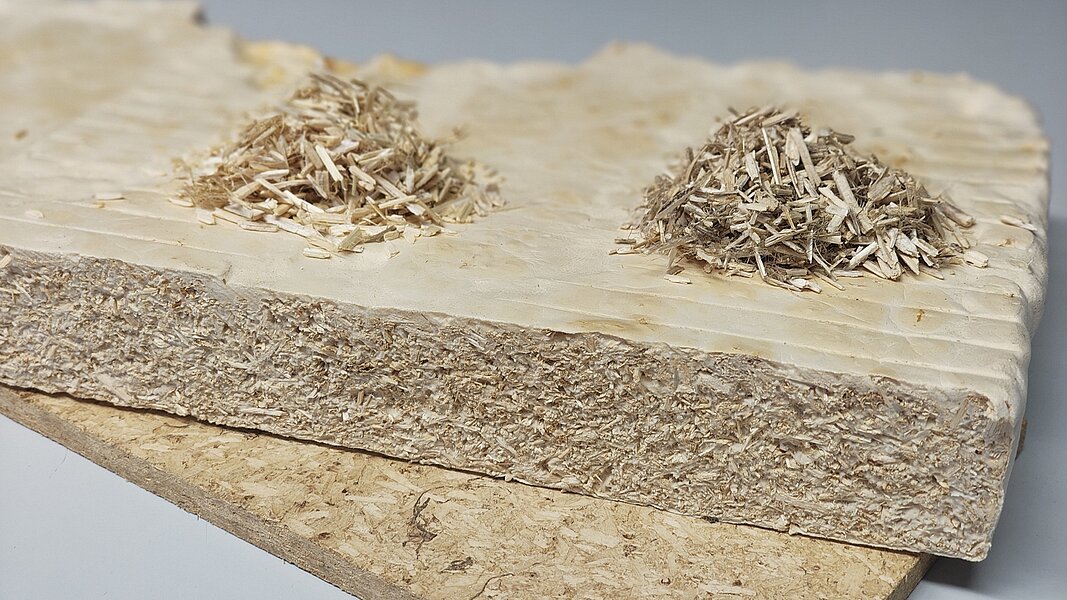
The SFB ‘MY-CO BUILD’ will receive 10.3 million euros in funding over the next four years and is dedicated to basic research on fungus-based materials from renewable raw materials from agriculture and forestry. Fungi – or more precisely, their mycelium – are used as a biological support and binding structure to allow substrates to grow together into stable yet lightweight, insulating materials. These fungus-based materials are produced without any additional binding agents or additives and are biodegradable.
The researchers' goal is to establish scientific foundations for defined manufacturing processes and reproducible property profiles of fungus-based materials. For the first time, this SFB brings together various disciplines – from biology to mechanics and physics to architecture – to holistically investigate the physical, chemical, thermal, acoustic and architectural property profiles of these materials. The research is complemented by the development of new mathematical models and the use of AI-based predictions for the sustainability and ageing resistance of the building materials.
From substrate to optimal material basis
ATB is involved in the SFB 1743 with the sub-project ‘Pretreatment and stabilisation of lignocellulosic substrates for fungal composites’ and contributes its expertise in the field of material utilisation of agricultural and wood-based biomass to the joint project. The focus is on the provision and pretreatment of plant substrates, which serve as a breeding ground and scaffold for fungal growth.
The central research questions aim to optimise the quality and predictability of substrate supply. On the one hand, the influence of storage and pre-treatment on the suitability of plant substrates, such as hemp fibre, for the production of fungal composites is to be defined. On the other hand, possibilities for adapting the substrate structure and composition for optimal fungal growth by means of thermo-physical processes are to be evaluated.
The ATB research team is building on its extensive experience in hemp cultivation and the design of the post-harvest phase and storage. In collaboration with the working groups "Bio-efficient Food Processing" (Dr O. Schlüter) and "Microbiome Management" (Dr A. Abdelfattah), the work encompasses:
- basic research and modelling for the provision and characterisation of the hemp substrate
- development and application of thermo-physical pre-treatment processes (also for wood-based substrates)
- analyses of the morphology, chemical composition and microbiome of the substrates after harvesting, storage and pre-treatment.
Dr Hans-Jörg Gusovius, leader of the work group Process Engineering for Fibre Crops at ATB, is looking forward to the challenges ahead:
‘The approval of the SFB ’MY-CO BUILD" is excellent news and a great success for all partners involved. This major project gives ATB a unique opportunity to contribute our many years of expertise in the provision and characterisation of agricultural biomass – especially hemp – directly to the development of a new, sustainable class of materials. I am looking forward to the collaboration with great excitement and optimism. The interdisciplinary structure of the SFB offers us a unique opportunity to jointly lay the scientific foundations for making fungal materials sustainable for the construction industry.‘
The research in SFB 1743 ’MY-CO BUILD" is directly in line with the systemic-technical bioeconomy research at ATB. The development of new, biologically produced and degradable materials from renewable raw materials creates the scientific basis for the transformation to a sustainable, bio-based circular economy. By establishing this new class of materials, we are directly supporting the German government's high-tech agenda and making a significant contribution to shaping a sustainable, bio-based world.
About SFB 1743:
Institutions participating in SFB 1743 ‘MY-CO BUILD: Biomanufacturing, characterisation and sustainability assessment of fungal-based building materials’:
TU Berlin
TU Munich
Karlsruhe Institute of Technology (KIT)
Bochum University of Applied Sciences
Leibniz Institute for Agricultural Engineering Potsdam-Bornim e.V. (ATB)
Aalborg University
Funding volume: €10.3 million
Duration: 2026 – 2029
Press release from TU Berlin on SFB 1743: https://www.tu.berlin/news/detail/baumaterialien-aus-pilzen
Contact:
Dr Hans-Jörg Gusovius
Work group leader Process Engineering for Fibre Crops
Telefon: +49 331 5699-316
E-Mail: hjgusovius@atb-potsdam.de